

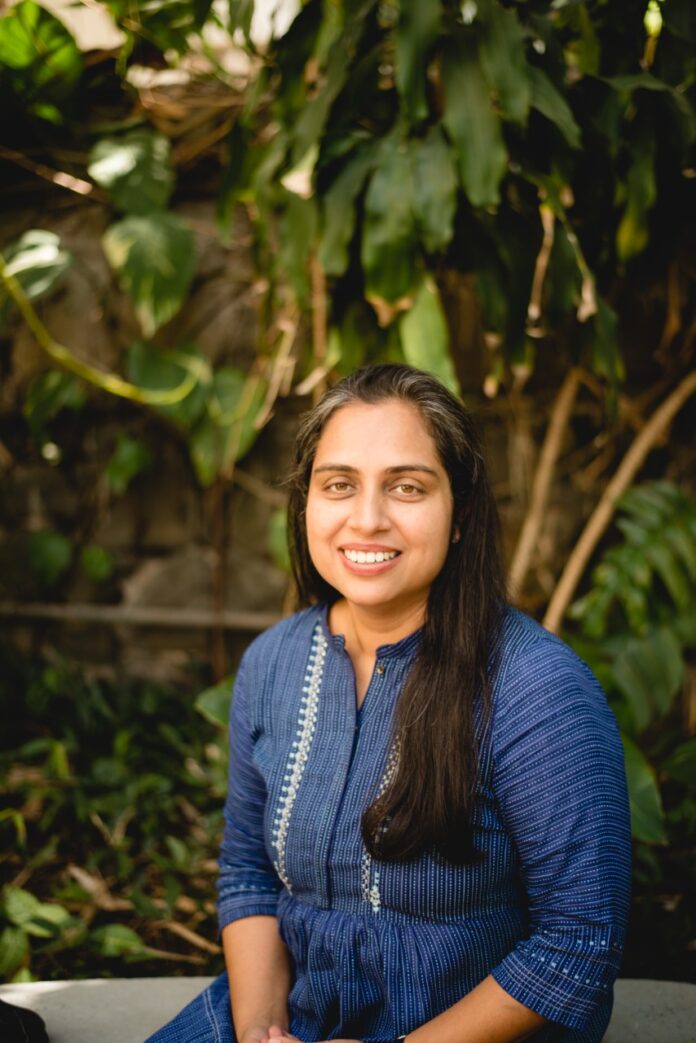
Introduction: In an industry often driven by scale, speed, and visual statement, Architect Rinka Bose D’Monte’s practice stands apart for its quiet clarity of intent. Through Atelier ARBO, she has shaped a body of work that moves between pre-engineered steel structures, learning environments, and nature-led spaces, yet remains anchored in empathy and observation. Her projects rarely chase spectacle. Instead, they ask grounded questions: How does a space feel to its users? How does architecture respond to childhood, learning, and emotional growth? How can steel be both efficient and expressive without overpowering context? In this conversation, Rinka reflects on building a non-hierarchical studio, designing for children, and discovering how material intelligence can coexist with social responsibility.
From founding Atelier ARBO to delivering over 25 projects, what motivated you to start your own practice, and how has the journey evolved?
Architecture, for me, has always been a sustained curiosity. It is a profession where you never truly feel complete, you remain a lifelong learner. That open-endedness is what drew me to architecture and continues to keep me invested.
My early professional years at two large structural engineering firms in Mumbai shaped my thinking in a fundamental way. Working on large-scale steel structures exposed me to the discipline and rigor of engineering logic. I learned to see structure not merely as support, but as a generator of spatial possibilities. That understanding still informs my work today.
After more than a decade working on residential and similar typologies, I began sensing a gradual shift in my interests. I found myself drawn to projects that carried deeper social and human value. Slowly, my focus moved toward pre-engineered steel structures and child-centric environments such as schools and learning spaces. The transition was not abrupt, but it unfolded over time. Today, we can see clear growth in both these sectors, which reassures us that this direction is relevant and needed.
We are also exploring bamboo alongside steel. Bamboo introduces warmth, tactility, and ecological intelligence, while steel offers precision, speed, and span. The conversation between these two materials is something we are keen to develop further.
Atelier ARBO functions as a collective rather than a hierarchical office. Influenced by the philosophical ideas of J. Krishnamurti, we consciously stepped away from rigid hierarchy. We wanted to create a studio where free thinking is encouraged and young architects feel comfortable expressing ideas. Our growth has been slow but intentional. We prefer meaningful projects over sheer volume. Seeing design ideas—especially in educational spaces—translate into lived environments that evolve with their users remains deeply fulfilling.
“We have grown slowly, but meaningfully… choosing projects that align with our values rather than just our portfolio.”
Atelier ARBO speaks of collective growth and social betterment. How do these ideas shape your daily design decisions?
At our studio, design begins with reflection rather than deliverables. We ask what kind of impact a space should create for its users and community. That question sets the tone for the entire process.
Because much of our work engages with children, observation becomes central. We spend time observing how children move through spaces, how they gather, where they feel comfortable, and what draws their attention. Their behaviour often reveals insights that formal briefs cannot capture. Observation, in many ways, is our most reliable design tool.
Our consultants are sensitive to this approach, which makes collaboration meaningful. When designing parks or play environments, the process itself carries joy. We believe enjoyment is not separate from professionalism; it often leads to more thoughtful outcomes.
We constantly question the necessity of interventions. Why is something needed? How will it improve everyday life? How can it create a meaningful experience with out being excessive?
Simplicity guides many of our decisions. We aim to create spaces that quietly influence daily life rather than dominate it.
Nature is never treated as an afterthought. Biophilic thinking informs our spatial strategies, material palettes, and environmental responses. We try to create living systems rather than static environments, spaces that uplift moods and foster connection over time.
You have worked extensively on learning environments. What defines your approach to educational architecture?
Designing for children requires humility & humbleness. Adult logic does not always apply. Children respond instinctively to their surroundings to scale, texture, light, and movement.
When we began working more deeply in child-centric spaces, we realised we needed to understand children before designing for them. We studied Montessori philosophies, free-play frameworks, and other pedagogical models. A child’s needs are simple, like running, climbing, sitting on the floor, observing, exploring. Yet behind these actions lies curiosity and emotional engagement.
This shifted our approach toward empathy, appropriate scale, and sensory richness. We consciously design from a child’s point of view. That means rethinking proportions, circulation, and materials. Learning, we believe, does not happen only inside classrooms. It unfolds in corridors, courtyards, under staircases, and around trees.
We collaborate closely with educators to translate pedagogy into spatial strategies. What distinguishes our work is the balance we try to maintain between the built environment and a child’s imagination. We are careful not to overdefine spaces. Children should feel free to interpret and explore them.
“Designing for children teaches you humility as you begin to see spaces at a different scale.”
How do you bring joy and creativity into educational spaces?
Children experience joy through exploration. They notice subtle environmental changes that adults often overlook. To design for them, we must relearn how to observe.
We create spaces with possibilities rather than prescriptions. Often, children use them in ways we never anticipated. That unpredictability is valuable, as it shows that the space is alive and adaptable.
Material richness plays an important role. Texture, warmth, daylight, and sensory variety help build comfort and memory. We try to create environments that feel inviting rather than instructional.
How does steel support your architectural ambitions?
My early exposure to airport and aircraft hangar projects revealed steel’s potential to me. Over time, I began seeing steel as a design enabler. It allows slenderness, large spans, and cantilevers that feel light and open.
There was once a perception that steel was only for industrial buildings. That mindset is changing. Steel offers solutions where concrete may be heavy or time-consuming. For villas and resorts, it allows openness and connection to nature. For schools, it supports modular construction with minimal disruption.
Steel also aligns with sustainability goals. It is recyclable, precise, and suitable for dry construction, which reduces site waste. Its true value often becomes evident after completion, when timelines are met and performance aligns with intent.
“Steel gives us the ability to design lightly on the land while thinking long-term.”
What excites you about modular and prefabricated systems?
Modular systems demand clarity. Every detail must be resolved early, which encourages discipline. Yet within that discipline lies creativity on how connections are expressed, how materials are layered, how flexibility is built in.
I am excited by how these systems can democratize good design. From rural schools to eco-resorts, they allow faster, cleaner construction. The challenge is turning something standardized into something soulful. That tension is what I enjoy.
As a woman leading a boutique practice, what leadership values guide you?
Empathy and openness. I strive to create a studio where people feel heard. Mentorship is mutual, and we learn from each other. I focus on creating space for diverse voices and reducing hierarchy.
A moment that reshaped your thinking?
During a rural school project, a child once said they wanted a school that felt like home. That stayed with me. It reminded me that architecture is not only about solving spatial problems but about emotional connection. Since then, listening deeply has become central to my practice.
Design Philosophy
Architecture should not prescribe behaviour; it should invite possibility.
Practice Note
Atelier ARBO works across architecture, interiors, and landscape with a focus on child-centric and sustainable environments. The studio consciously operates as a collaborative collective rather than a top-down hierarchy.
Editor’s Note:
In a time when architecture often celebrates speed and spectacle, Rinka Bose D’Monte’s approach feels quietly radical. By designing from a child’s perspective and treating steel as a tool for sensitivity rather than dominance, her work suggests an alternative trajectory for contemporary practice, one rooted in empathy, observation, and long-term responsibility.