


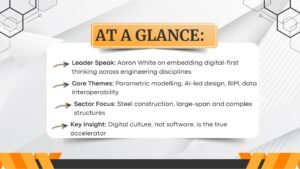
Introduction: Digital transformation in structural engineering is no longer about tools, it is about mindset, systems, and culture. At Walter P Moore, one of the world’s most respected engineering firms, this transformation is being steered from the top by AARON WHITE, Managing Principal & Chief Information + Digital Officer.
In this exclusive conversation with SSMB, White offers a candid look into how digital thinking is embedded across design, modelling, fabrication, and construction at the firm. From parametric modelling and seamless data pipelines to AI-driven structural innovation, he shares how technology is accelerating delivery, reshaping steel construction, and redefining collaboration across the value chain.
FOSTERING A DIGITAL-FIRST CULTURE
As Chief Information and Digital Officer, how have you fostered a digital culture at Walter P Moore that encourages collaboration across design, fabrication, modelling, and construction teams?
Our digital approach has been intentionally consistent across the organisation. We encourage teams to think digitally in everything they do across processes, workflows, and decision-making. Importantly, the culture we have built is inclusive. Innovation is not limited to a single, separate group; everyone is encouraged to participate, contribute ideas, and challenge the status quo. That breadth of participation is what truly drives meaningful and sustained innovation.
“Digital transformation works best when innovation is inclusive—not centralised.”
PLATFORMS POWERING SPEED AND FLUIDITY
You emphasise fluidity and accelerated pace in project delivery. Which core digital platforms have been most transformative in supporting this approach?
Two platforms stand out. The first was our early adoption of parametric modelling around 2011–2012, which became a foundational driver of our broader digital transformation. The second is our CID platform, which enables seamless data transfer from structural analysis directly into documentation, and even fabrication models.
This interoperability allows us to deeply study portions of a model, discard them if necessary, and regenerate alternatives efficiently. That flexibility fundamentally changes how quickly and confidently we can move through design iterations.
“Parametric thinking gave us speed; seamless data flow gave us confidence.”
Digital Backbone at Walter P Moore
- Early adoption of parametric modelling
- CID platform linking analysis, documentation, and fabrication
- Model regeneration enabling rapid design iteration
- Data-driven workflows across steel, concrete, and hybrid systems
ALIGNING DIGITAL CAPABILITY WITH CLIENT VISION
You are known for understanding clients’ needs and expanding their vision. How do you structure early-stage digital charrettes or discovery workshops to align technical possibilities with client goals?
It always begins with developing a deep understanding of the client’s market sector and the purpose of the project. Every building has a different objective, and clarity at that stage is essential. We consciously place ourselves in the client’s position and draw on targeted market knowledge to understand what truly matters to them.
Our project managers engage directly with clients early on, and those insights are then discussed collaboratively within the team. This ensures that technical possibilities are explored in a way that aligns directly with the client’s vision and business objectives.
AI AND THE NEXT WAVE OF STRUCTURAL INTELLIGENCE
You have driven continuous technology-enabled improvements across the firm. Which emerging tools are you most excited to pilot next?
I am particularly excited about the role AI can play in enhancing structural solutions. We are already developing tools that allow us to move seamlessly from early conceptual ideas to fully developed design solutions.
The real value lies in accelerating processes that would traditionally take much longer, whether we are evaluating concrete systems, steel structures, or hybrid solutions. These tools enable us to assess multiple construction systems efficiently and identify optimal solutions much earlier in the project lifecycle.
“AI allows us to compress months of exploration into days of insight.”
RETHINKING STEEL CONSTRUCTION THROUGH AI
What do you see as the future of AI in steel construction?
The possibilities are virtually limitless. In steel construction especially, there is tremendous potential to rethink long-established approaches. If we look back at fabrication and erection methodologies that date to the 1950s and 1960s, AI gives us an opportunity to fundamentally reimagine them.
This could include entirely new fabrication logic, innovative erection sequences, and hybrid steel–concrete solutions that significantly improve efficiency, flexibility, and overall performance of buildings.
Where AI Can Disrupt Steel Construction
- Fabrication logic and sequencing
- Erection planning and constructability analysis
- Hybrid steel–concrete optimisation
- Performance-led structural systems
DRIVING ADOPTION ACROSS TEAMS
How do you encourage team adoption of new digital processes, ensuring that engineers, contractors, and fabricators realise the efficiency benefits?
We begin by clearly communicating where we are headed, both in terms of tools and expected deliverables. Continuous messaging around industry trends and best practices helps teams and clients understand the “why” behind these changes.
Adoption varies, as some people adapt quickly, others take longer. That’s natural. What matters is consistent communication and reinforcement over time. As people begin to experience the efficiency and clarity these tools bring, alignment follows organically.
THE NEXT FRONTIER FOR LARGE-SPAN STRUCTURES
Looking ahead, what do you see as the next frontier in combining structural engineering expertise with digital innovation for large-span and complex projects?
The next frontier lies in developing advanced tools that allow us to explore multiple configurations, fabrication strategies, and erection sequences at a very early stage. By evaluating these options upfront, we gain a comprehensive understanding of project implications right at the concept level.
This integrated approach leads to more efficient decision-making, greater innovation, and ultimately more robust solutions for complex, large-span structures.
“The future lies in understanding every possibility before committing to one.”
SSMB POV:
Aaron White’s perspective underscores a larger truth for the steel construction ecosystem: the future belongs to organisations that treat digital capability not as an add-on, but as core infrastructure. As steel structures grow more complex and timelines compress, leadership-driven digital integration will define the next era of engineering excellence.