

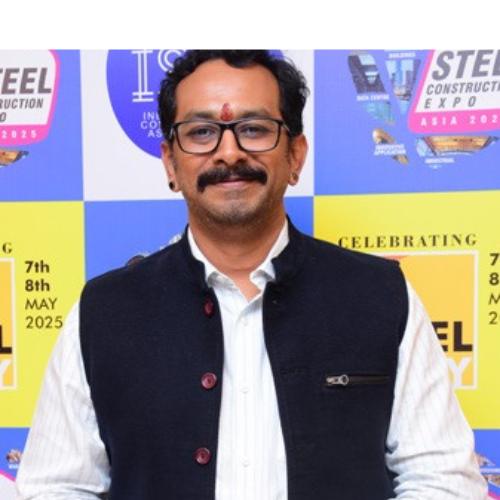
Introduction: As contemporary architecture moves toward greater flexibility, speed, and sustainability, the materials architects choose are increasingly shaping not just buildings, but urban futures. For Laxman Ramkrishna, Principal Architect, LN Design, steel represents a material that aligns seamlessly with the aspirations of modern architecture, offering freedom of form, efficiency of space, and adaptability over time. In this in-depth conversation, he shares how steel has become integral to his design philosophy, enabling new-age spatial experiences while responding to the evolving demands of Indian cities.
What role does steel play in achieving architectural versatility in your projects?
Our ambition as architects has always been to design spaces that feel progressive, spaces with complex heights, layered volumes, and a certain lightness that responds to contemporary lifestyles. Steel enables this with remarkable ease, provided the right design and engineering expertise is involved. It allows us to push spatial boundaries without making the structure visually dominant. Equally important is the speed it offers. In today’s environment, where time is a defining factor, steel helps us translate ideas into built form far more efficiently than conventional systems.
“Steel gives us the freedom to create complex, new-age spaces without letting the structure overpower the architecture.”
How do you balance aesthetics and functionality when designing with steel?
Steel naturally lends itself to a more efficient structural language. The spans it offers and the slenderness of its members mean that structural intrusion into living or working spaces is significantly reduced. Compared to RCC, which often requires additional treatments or compensations, steel allows the structure itself to participate in the aesthetic narrative. In modern architecture, this honesty is valuable. The material aligns well with contemporary sensibilities, where clarity, openness, and efficiency are as important as visual expression.
“In new-age buildings, steel doesn’t need to be hidden, it already belongs.”
How does designing with steel support your approach to sustainability and green building practices?
Steel is one of the most forward-looking materials when it comes to sustainability. Its ability to be dismantled, reused, and salvaged adds significant value in green building frameworks today. As Indian cities evolve over the next few decades, many buildings will need to be adapted, retrofitted, or reconfigured rather than demolished. Steel offers the flexibility to support that change. Beyond rating systems, the material’s potential for reuse and its relevance to emerging carbon credit mechanisms make it far more sustainable in the long run than traditional RCC construction.
What are some common misconceptions about designing with steel that you have encountered?
There is still a perception in India that steel construction is complex or difficult to execute, largely due to unfamiliarity. Many assume that finding the right consultants, fabricators, or contractors is a challenge. In reality, the ecosystem has matured significantly. There are capable players across the value chain who are eager to collaborate. The industry is at a transition point, and this is precisely the right time to engage with steel. The hesitation often lies not in availability, but in mindset.
“The ecosystem is ready. What needs to evolve is our willingness to explore.”
How does steel compare with other materials when addressing modern architectural challenges?
Steel responds exceptionally well to the demands of modern architecture. As buildings grow taller, RCC structures require increasingly large columns, which reduce usable space, particularly at lower levels. Steel, by contrast, allows for slender columns and lighter structures, preserving spatial efficiency while also accelerating construction. Today’s architecture demands a balance of elegance and efficiency, class and time. Steel delivers on both fronts, making it particularly relevant for contemporary urban buildings.
What is the most creative or unconventional use of steel you have encountered or implemented?
One of the most memorable projects I have witnessed involved a building constructed from the top down rather than the conventional bottom-up approach. Such a sequence is possible only with steel. While the material provides extraordinary flexibility, creativity ultimately depends on the architect’s imagination. Steel simply expands the range of what is possible, offering opportunities to rethink construction logic itself.
How do you approach collaboration with engineers and fabricators on steel-intensive projects?
Collaboration becomes far more critical when working with steel. In our projects, we make it a point to involve all stakeholders like structural engineers, fabricators, and service consultants from the very beginning. Unlike RCC, where outcomes are often predictable due to long-established practices, steel allows for multiple design and execution possibilities. Early discussions help us integrate services within beams, optimise spans, and align expectations. This collective approach invariably leads to better outcomes, both architecturally and structurally.
What advice would you offer to young architects exploring steel as a design medium?
My advice would be to move beyond the comfort of conventional grids and standard forms. Steel gives you the opportunity to explore new geometries and spatial possibilities. Engage with people across the industry, understand different perspectives, and expose yourself to diverse ways of thinking. Architecture is evolving rapidly, and steel equips young architects to respond more effectively to the challenges of a new age.
“Unleash your creativity, steel will support it.”
How do you see steel redefining urban landscapes and infrastructure in India?
Steel is already making a tangible impact, particularly in retrofit and infrastructure projects. We have seen bridges and buildings where RCC has been replaced or supplemented with steel to achieve faster execution and minimal disruption. In dense cities like Mumbai and Delhi, where redevelopment and adaptation will become increasingly common, steel’s ability to be prefabricated off-site and assembled quickly on location will be invaluable. This level of efficiency and adaptability simply is not possible with any other material.
“India’s urban future will depend on how intelligently we adapt—and steel makes that possible.”
Why It Matters:
As Indian architecture grapples with the pressures of time, space, and sustainability, steel is emerging as a material that offers clarity rather than compromise. It allows architects to design lighter structures, build faster, and plan for change over time. For practices like LN Design, steel is not merely a construction choice, it is a design philosophy that aligns architecture with the realities of a rapidly evolving urban landscape.