

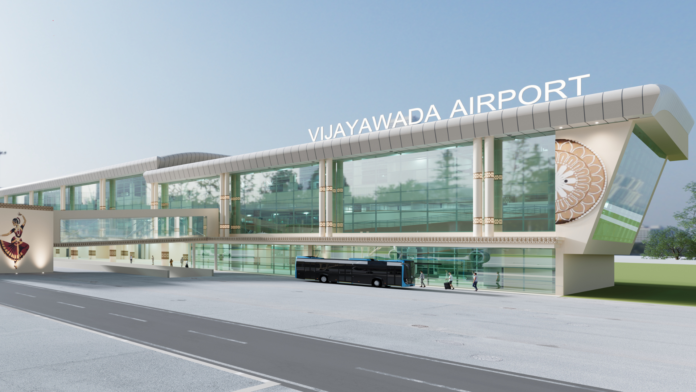
As India’s aviation landscape expands rapidly into Tier-2 and Tier-3 cities, the nature of airport infrastructure is undergoing a critical transformation. Beyond handling rising passenger volumes, new terminals are increasingly expected to embody environmental responsibility, operational efficiency, and long-term resilience. The New Integrated Terminal Building (NITB) at Vijayawada Airport, engineered by Meinhardt Singapore Pte. Ltd., represents a thoughtful response to these evolving expectations.
Conceived as a model of sustainable aviation infrastructure, the terminal integrates climate-responsive design, resource-efficient engineering, and advanced building technologies into a unified architectural and structural framework. At the heart of this approach lies the strategic use of structural steel systems, which not only enable large-span passenger halls and architectural clarity but also support the project’s broader sustainability objectives.
The result is a terminal that balances functionality, passenger comfort, and environmental performance—demonstrating how green infrastructure can be successfully embedded in regional airports that are rapidly becoming key nodes in India’s aviation network.
DESIGNING WITH CLIMATE AND CONTEXT
The sustainability vision for the Vijayawada Airport terminal began at the earliest stage of master planning. Rather than treating sustainability as an additional layer, the design team integrated environmental strategies directly into the spatial planning and architectural concept.
Site orientation and landscape planning were carefully studied to optimise solar exposure and prevailing wind patterns. These measures help mitigate the urban heat island effect while creating a more comfortable microclimate around the terminal building. The thoughtful arrangement of built form and open spaces contributes to a reduction of approximately 10–12 percent in cooling loads, improving the building’s overall energy efficiency.
Passive environmental considerations continued to shape the terminal’s design at the architectural scale. Solar path studies informed the placement of shading elements, roof projections, and façade systems, ensuring that solar heat gain is minimised while natural daylight is maximised across passenger areas.
Through these climate-responsive strategies, the terminal establishes a design approach where architecture itself becomes an active contributor to sustainability.
“Structural steel enabled the terminal’s large column-free spans while maintaining structural efficiency and architectural lightness.”
STEEL AS THE STRUCTURAL BACKBONE
The architectural vision of the terminal required expansive, uninterrupted interior spaces capable of accommodating high passenger volumes and flexible circulation patterns. Achieving these requirements demanded structural systems capable of spanning large distances without excessive structural depth or intrusive columns.
Structural steel emerged as the ideal material to meet these demands.
Long-span steel trusses form the primary structural framework of the terminal roof, allowing the concourse spaces below to remain largely column-free. This structural clarity enhances both passenger movement and spatial visibility, which are essential aspects of airport functionality.
Beyond enabling large spans, steel also supports the architectural expression of the building. The slender structural members allow the roof to visually “float” above the terminal halls, creating a sense of lightness and openness that defines the passenger experience.
The advantages of steel extend further into construction efficiency. Prefabricated steel components allowed rapid erection on site, reducing construction timelines while maintaining high precision and quality control. The material’s relatively lighter weight compared to conventional systems also reduced foundation loads, improving overall structural efficiency.
Importantly, steel introduces a level of adaptability that aligns with the long-term growth trajectory of airports. The structural framework allows modular expansion in the future, enabling the terminal to evolve without significant disruption to operations.
MATERIAL OPTIMISATION AND LIFECYCLE THINKING
A significant aspect of the project’s sustainability strategy involved optimising structural materials while considering long-term lifecycle performance.
The structural system incorporates hollow steel sections, selected for their excellent strength-to-weight ratio. These sections enable large spans with reduced material usage, helping decrease the overall quantity of steel required without compromising structural integrity. The lighter structural components also simplified transportation and erection, further contributing to efficiency during construction.
Material optimisation extended beyond structural efficiency to address embodied carbon considerations. Locally sourced materials were prioritised wherever possible, reducing transportation emissions and supporting regional supply chains. In addition, steel components with recycled content were specified where feasible, contributing to lower lifecycle environmental impact.
The design team adopted a holistic lifecycle perspective, balancing initial material use with long-term performance benefits such as durability, reduced maintenance requirements, and lower operational energy demand.
“Green infrastructure is most effective when sustainability is embedded from master planning to detailing, not added later.”
BALANCING STEEL STRUCTURES WITH THERMAL PERFORMANCE
While steel provides clear structural and construction advantages, careful detailing was required to ensure that energy performance remained uncompromised.
The roof and wall systems were designed as high-performance insulated assemblies, incorporating reflective finishes and robust insulation layers to reduce heat ingress. Double-glazed skylights allow natural daylight to penetrate deep into the terminal interior while maintaining thermal insulation.
Thermal breaks were incorporated at structural junctions to prevent heat bridging, ensuring that the steel framework integrates effectively with the building envelope. In areas where thermal mass was beneficial, composite steel–concrete systems were introduced to enhance indoor comfort and temperature stability.
Through this balanced approach, the project demonstrates how steel-intensive structures can still achieve strong energy performance when integrated with high-performance envelope systems.
PASSIVE DESIGN FOR ENERGY EFFICIENCY
Passive design strategies play a crucial role in reducing the building’s operational energy demand. The terminal’s orientation and massing were carefully optimised to limit direct solar exposure while encouraging daylight penetration into passenger areas.
Deep roof overhangs, shading fins, and façade canopies act as passive solar control elements, preventing glare and excessive heat gain. At the same time, generous skylights allow natural daylight to illuminate large portions of the terminal interior during daytime operations, reducing reliance on artificial lighting.
Native landscaping further contributes to environmental performance by improving the microclimate around the building and lowering ambient temperatures in surrounding areas.
Collectively, these passive measures contribute to an estimated 20–25 percent reduction in energy consumption compared to conventional airport terminals.
“Steel’s prefabrication and modular flexibility reduced construction timelines while supporting long-term adaptability.”
SMART MEP SYSTEMS DRIVING EFFICIENCY
The mechanical, electrical, and plumbing systems of the terminal have been designed as the operational backbone of its sustainability vision.
Zoned HVAC systems allow cooling to be tailored according to occupancy levels across different parts of the terminal, preventing unnecessary energy consumption in less-used areas. Demand-based air distribution ensures that passenger comfort is maintained while avoiding excessive conditioning.
Sensor-based lighting and occupancy-driven controls further enhance energy efficiency by automatically adjusting lighting levels based on real-time usage patterns. A fully integrated Building Management System (BMS) continuously monitors energy performance across HVAC, lighting, and electrical systems, enabling dynamic optimisation throughout daily operations.
These measures together deliver operational energy savings of approximately 15–18 percent.
RENEWABLE ENERGY AND WATER EFFICIENCY
Renewable energy forms another important pillar of the terminal’s sustainability strategy. On-site solar photovoltaic systems generate approximately 10–15 per cent of the building’s energy demand, reducing dependence on grid-based fossil fuel energy.
Water conservation measures are equally comprehensive. Rainwater harvesting systems capture and store precipitation for reuse, while wastewater recycling systems treat greywater for applications such as HVAC cooling towers and landscape irrigation.
Low-flow plumbing fixtures throughout the terminal further reduce water consumption, enabling an overall 35–40 percent reduction in potable water use compared to conventional airport facilities.
INTEGRATED DESIGN COLLABORATION
One of the defining characteristics of the Vijayawada Airport project is the level of coordination achieved between architectural, structural, and MEP disciplines.
From the earliest stages of design, all teams operated within a unified sustainability framework. Building orientation, steel structural systems, façade design, and service infrastructure were developed simultaneously rather than sequentially.
Advanced modelling tools such as BIM facilitated interdisciplinary coordination, enabling performance simulations, clash detection, and design optimisation. This collaborative process ensured that every aspect of the terminal, from structural spans to service routing, supported the project’s environmental objectives.
The result is a building that functions not as a collection of isolated systems but as a cohesive, high-performance environment.
“The Vijayawada terminal demonstrates that Tier-2 cities can lead the way in climate-responsive aviation infrastructure.”
SETTING A BENCHMARK FOR REGIONAL AIRPORTS
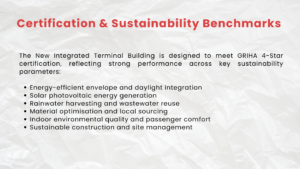
The Vijayawada Airport terminal is targeting GRIHA 4-Star certification, reflecting strong performance across energy efficiency, water conservation, material optimisation, and indoor environmental quality.
More importantly, the project illustrates a broader shift in India’s infrastructure development strategy. Sustainable design is no longer confined to major metropolitan projects. Regional airports, often the gateways to rapidly growing cities, are increasingly adopting environmentally responsible construction practices.
By integrating passive design, steel-intensive structural systems, renewable energy, and intelligent building technologies, the Vijayawada Airport terminal establishes a scalable model for sustainable aviation infrastructure across India.
Why It Matters:
The New Integrated Terminal Building at Vijayawada Airport highlights how structural steel can play a pivotal role in enabling sustainable infrastructure. Its ability to create large, adaptable spaces with reduced material intensity makes it particularly suited to complex facilities such as airports. As India’s regional aviation network continues to expand, projects like Vijayawada Airport demonstrate that green, steel-driven infrastructure can become the new standard for future-ready airport development.
Green Design Strategies
The Vijayawada Airport terminal integrates a range of sustainability measures that reduce both operational energy demand and environmental impact:
Climate-Responsive Site Planning
Strategic orientation, landscape design, and microclimate management help reduce heat island effects and lower cooling loads by an estimated 10–12%.
Energy-Efficient Building Envelope
High-performance glazing, insulated roofing systems, and passive shading elements significantly minimise solar heat gain, contributing to 20–25% energy savings compared to conventional terminals.
Passive Daylighting
Large skylights and deep roof projections allow natural daylight to penetrate passenger areas, reducing dependence on artificial lighting during daytime operations.
Renewable Energy Integration
On-site solar photovoltaic systems generate approximately 10–15% of the terminal’s energy demand, lowering reliance on grid-based fossil energy.
Smart Building Systems
Sensor-based lighting, occupancy-driven HVAC zoning, and advanced building management systems optimise operational energy use by up to 15–18%.
Water Conservation Systems
Rainwater harvesting, wastewater recycling, and low-flow fixtures enable up to 40% reduction in potable water consumption.